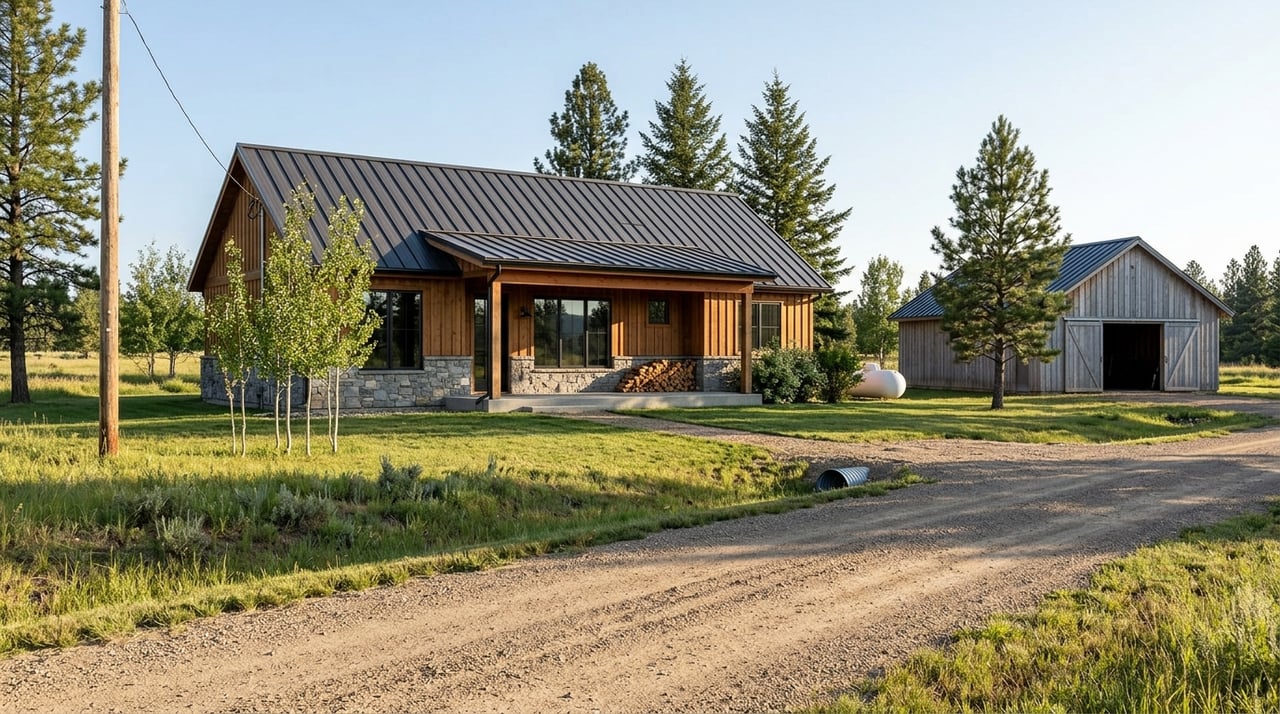
If you are dreaming about acreage near Hamilton, it is easy to focus on the views, elbow room, and future possibilities. But before you commit, you need to know whether the land will actually support the way you plan to live on it. A smart acreage purchase depends on more than beauty alone, and this guide will help you understand the key checks to make before you move forward. Let’s dive in.
Why acreage near Hamilton needs extra review
Buying rural property near Hamilton is often very different from buying an in-town home. Parcels outside city limits may rely on private wells, septic systems, private or partially maintained roads, and recorded restrictions that do not show up in a quick online search.
That is especially important when it comes to utilities. The City of Hamilton states that city water and sewer serve the city, and its adopted plan notes that potable water is supplied to city residents and only a limited number of properties southeast of city limits. In other words, you should not assume municipal service is available just because a property is close to town, according to the City of Hamilton materials.
Check road access first
For acreage, road access is not a small detail. It affects how you reach the property year-round, who handles maintenance, and whether future improvements may require county approval.
Ravalli County says it has about 1,450 miles of public roadway, with about 550 miles maintained by the county road department. The county also specifically advises buyers in the Bitterroot Valley to investigate road condition and maintenance before purchasing, which makes access one of the first issues to confirm, not one of the last. You can review that guidance through the county’s Road & Bridge information.
You should also ask whether the road is county-maintained or private, who handles snow removal and grading, and whether there is an existing legal access point. Ravalli County requires approach permits for field, residential, and commercial access points, so driveway access may already be part of the property’s due diligence.
Use GIS as a tool, not proof
Maps can be helpful when you start researching acreage, but they are not the same thing as the legal record. That distinction matters when you are looking at boundaries, access routes, or possible easements.
Ravalli County’s GIS office says it can help with mapping and physical addresses, but it is not a surveyor, cannot interpret deeds or legal descriptions, and its maps are for general reference only. The county is clear that the official record controls, which means GIS should be treated as a screening tool rather than final proof. You can review those limitations on the county’s GIS page.
If boundary lines, road easements, or access routes seem unclear, that is your signal to dig deeper. A title commitment, recorded easement review, and in some cases a survey can give you a more reliable picture than a map layer alone.
Verify the water source carefully
Water is one of the biggest practical questions with acreage near Hamilton. If the property is not served by a public system, you may be relying on a private well, and that changes your responsibilities as an owner.
The Montana Department of Environmental Quality says private wells are not regulated for water quality, which means owners are responsible for their own testing. DEQ recommends an annual well check-up that includes inspection of the wellhead and pressure tank, along with testing for coliform bacteria and nitrates at a minimum. You can find that guidance from Montana DEQ.
That is why you should verify the property’s water source early in the process. If there is a private well, ask about testing history, production information if available, and whether there are any shared-use arrangements that need to be documented.
Understand water rights separately
A well or ditch on a property does not automatically mean you have legal rights to use water however you want. For buyers considering irrigation, stock use, or expanded domestic use, water rights need their own review.
The Montana Department of Natural Resources and Conservation says a water right is required for the majority of water uses to be valid, legal, and defensible. DNRC also notes that a new or expanded use of surface water or groundwater after June 30, 1973 usually requires a permit or certificate, and that a well log by itself does not create a water right. You can review that on the DNRC water rights page.
This is a key point for acreage buyers with plans for livestock, irrigation, gardens, or future expansion. If water is delivered through a city, association, irrigation district, or ditch company, the right may belong to that entity rather than to the parcel owner.
Review septic feasibility before closing
Septic is another major checkpoint for rural property near Hamilton. Even if a parcel looks buildable, the septic process may involve site-specific requirements that affect cost, timing, or feasibility.
Ravalli County’s septic permit process includes several important steps. The county says the application must be signed by all property owners on record, a site evaluation is required if the system has not already received DEQ approval, groundwater monitoring may be required where high groundwater is indicated, and a floodplain determination is required if the septic system is within 300 feet of a delineated floodplain. The county also states that a legal property address is needed to issue the permit. You can review those requirements on the county’s Septic Permits page.
For a buyer, the takeaway is simple: do not assume septic will be easy just because neighboring properties have homes on them. Verify permit history, site evaluation records, and any floodplain or groundwater issues before you commit.
Watch for floodplain impacts
Floodplain questions can affect more than insurance conversations. In Ravalli County, floodplain status can directly influence septic permitting and other development planning.
The county requires a floodplain determination if the septic system is within 300 feet of a delineated floodplain. That means floodplain review is not just a background item. It can become part of whether and how the property can support your intended use.
Check zoning, covenants, and future use limits
Many buyers look at acreage and imagine future flexibility, such as adding structures, keeping animals, or splitting land later. But those possibilities may be limited by zoning, subdivision history, covenants, easements, or other recorded restrictions.
Ravalli County says its zoning system is not one-size-fits-all. A citizen-initiated zoning district requires signatures from at least 60% of the freeholders in the proposed district, the district must be at least 40 acres, and if adopted it is enforceable by the county. The county also notes that subdivision questions in the planning jurisdictions of Darby, Hamilton, Pinesdale, or Stevensville should go to the relevant office. You can review that on the county’s Zoning page.
Because county GIS is only a reference tool, you should also verify recorded covenants, easements, and restrictions through the Clerk and Recorder records and your title commitment. That is often where the most important future-use limitations show up.
Plan for wildfire readiness and upkeep
Owning acreage often means more ongoing responsibility than owning a lot in town. In the Hamilton area, wildfire preparedness is one of the clearest examples.
DNRC says the Home Ignition Zone typically extends up to 200 feet around a home, and that the condition of the home and surrounding vegetation has the biggest influence on whether it ignites. DNRC also says embers are responsible for more than 90% of homes destroyed by wildfire, with guidance focused on the 0 to 5 foot, 5 to 30 foot, and 30 to 100 foot zones around structures. You can learn more through the state’s wildfire prevention and preparedness guidance.
If the property has timber, brush, pasture, or heavy vegetation, ask what kind of seasonal maintenance will be needed. Ravalli County also approved its Community Wildfire Protection Plan on February 20, 2024, which reinforces that this is an active local planning issue.
Know the ongoing land management rules
Acreage ownership also brings recurring responsibilities that first-time rural buyers may not expect. Burning rules, weed control, and roadside maintenance can all become part of your regular ownership routine.
Ravalli County’s burn permit program covers March 1 through November 30, while winter burning uses DEQ permits. The county Weed District can help identify noxious weeds and operates a roadside maintenance program, which can be especially relevant if your property includes pasture, brush, ditch banks, or shared frontage. You can start with the county’s Burning Permits information.
A practical acreage due diligence list
Before you write an offer on acreage near Hamilton, make sure you have answers to these core questions:
- Is the road county-maintained or private?
- Who handles grading, snow removal, and general road upkeep?
- Does the property have legal access, and is an approach permit already in place if needed?
- Is the water source municipal, private well, or something shared?
- If there is a private well, what testing and maintenance history is available?
- Are there any water rights, ditch shares, or association supply arrangements tied to the parcel?
- What is the septic permit history, and has the site been evaluated for future use?
- Is any part of the property or proposed septic area near a delineated floodplain?
- Does the parcel already have a legal property address for permit purposes?
- What do the title commitment and recorded documents show for easements, covenants, and restrictions?
- Are there zoning or subdivision rules that affect building plans or future splits?
- What ongoing wildfire mitigation, weed control, and burn-permit responsibilities come with the land?
The bottom line on Hamilton-area acreage
Buying acreage near Hamilton can be a great fit if you want space, privacy, and room for a different kind of Montana lifestyle. But the right question is not only whether you love the land. It is whether you can use it safely, legally, and realistically based on access, water, septic, restrictions, and ongoing maintenance.
Careful due diligence is what protects you. If you want experienced, detail-focused guidance as you evaluate Montana land and lifestyle properties, connect with Susan Raub for thoughtful representation built around education, protection, and clear advice.
FAQs
What should you verify first when buying acreage near Hamilton?
- Start with road access, maintenance responsibility, legal access points, and whether any approach permit is required through Ravalli County.
Does acreage near Hamilton usually have city water and sewer?
- Not always. City utilities should never be assumed just because a parcel is close to town, so you need to verify the actual water and sewer service available to the property.
Why do water rights matter for Hamilton-area acreage?
- Water rights matter because a water source on the property does not automatically give you legal rights for uses like irrigation, stock water, or expanded domestic use.
What septic issues should buyers review on rural property near Hamilton?
- You should review permit history, site evaluation requirements, groundwater concerns, floodplain determinations, and whether the parcel has a legal property address for permit processing.
How important is wildfire planning for acreage in Ravalli County?
- Wildfire planning is very important because vegetation, home condition, and ember exposure can strongly affect risk, and rural ownership often requires regular mitigation work around structures.
Can county GIS maps confirm acreage boundaries and easements in Ravalli County?
- No. Ravalli County says GIS maps are for general reference only, so buyers should rely on official records, title review, and a survey when boundaries or easements are unclear.